

Mechanical Pinning & Structural Stabilization
Stop the Cycle of Recurrent Cracking.
If you have repaired a terrazzo crack only to see it reappear in the exact same spot, you have a substrate problem, not a surface problem. Standard epoxy fills cannot withstand the vertical or lateral shifting of a building’s concrete slab.
At TerCon Systems, we utilize Mechanical Pinning, a structural engineering technique that “stitches” the fractured slab back together. By bridging the crack beneath the surface, we neutralize movement and provide a permanent foundation for a flawless terrazzo finish.
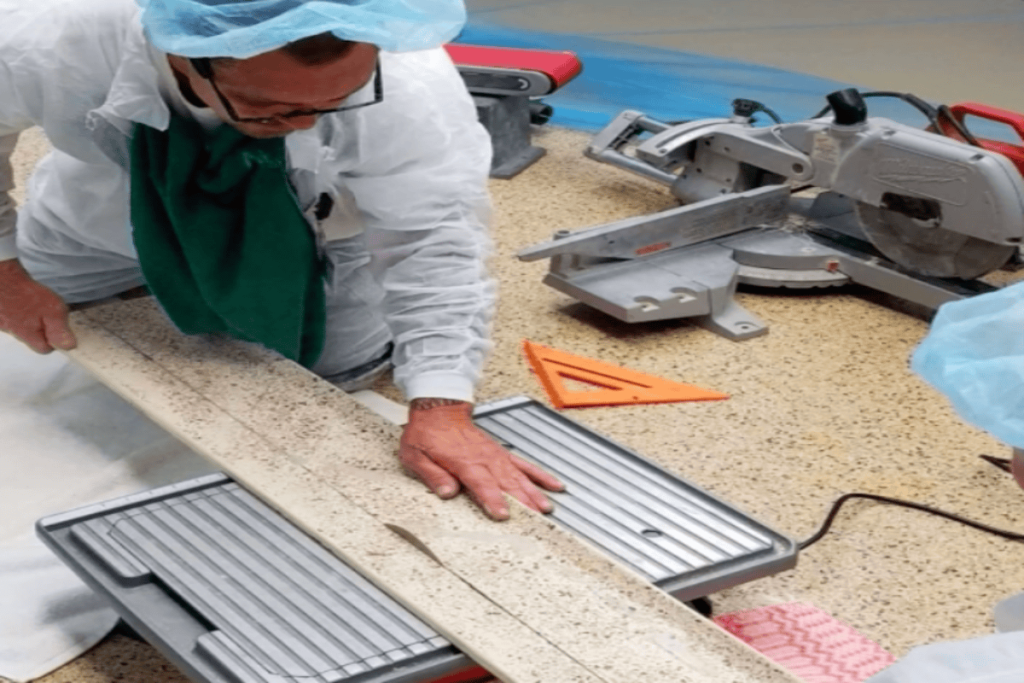
The TerCon Pinning Process: "Stitching" the Slab
We don’t just cover the crack; we reinforce the floor’s skeleton using a four-stage engineering protocol.
Structural Diagnostics
We analyze crack patterns to identify settlement (vertical) vs. expansion (lateral) movement. This determines the exact angle and depth required for the reinforcement pins.
Precision "Stitch" Boring
Using dust-shrouded drills, we create a series of channels perpendicular to the crack. These channels are engineered to house high-tensile reinforcement rods.
Chemical Anchoring
We insert industrial-grade carbon steel or fiberglass pins into the channels. These are encapsulated in high-modulus structural resin, bonding the pin to the concrete at a molecular level.
Monolithic Capping
Once stabilized, we cap the repair with a custom-matched terrazzo matrix. Because the pin prevents the slab from shifting, the surface repair remains intact for decades.
When is Mechanical Pinning Required?

Historic Restoration
For 50+ year-old buildings where the slab has settled unevenly over time.

Heavy Industrial Zones
Where forklifts or machinery cause “slab curl” or constant vibration.

High-Traffic Hubs
Airports or stations where constant footfall creates structural fatigue.
Structural Fissures
Any crack wider than 1/8th of an inch requires internal reinforcement.
Structural Stabilization FAQ
Yes. While epoxy has great tensile strength, it cannot handle the shear force of a shifting slab on its own. The pin acts as "rebar" for your repair, providing the physical backbone that resin lacks.
No. Pins are installed deep within the concrete substrate. Once we apply the color-matched terrazzo "cap" and diamond-polish the area, the structural reinforcement is completely invisible.
We use precision, low-impact boring tools designed for occupied buildings. The noise is localized and significantly less invasive than traditional "jackhammer and replace" methods.
If a crack has reopened after a previous repair, or if one side of the crack is higher than the other (lippage), it is a sign of structural movement. We use level-sensing tools during our evaluation to confirm.
Yes. We utilize micro-pinning techniques for terrazzo stairs and stringers where structural integrity is a critical safety concern.
“We don’t just fix the surface; we solve the structural instability underneath.”
End the cycle
of failed repairs.
A recurring crack is an active threat to your floor's longevity. Let our technical team provide a permanent, engineered solution.
Schedule Your Technical EvaluationCall 810-908-0511