

What Facility Managers Wish They Knew Before Replacing Terrazzo
For many facility managers, terrazzo flooring is something they inherit rather than choose. It may have been installed decades ago by a previous owner, hidden beneath years of wear, or overlooked during a building upgrade. When cracks appear, stains become noticeable, or the floor loses its shine, replacement often looks like the obvious solution.
Many facility managers who move forward with replacement, however, later discover that they may not have needed to replace the floor at all.
Across schools, hospitals, airports, government facilities, and commercial buildings, countless terrazzo floors have been removed while they still had years of service life remaining. In many cases, professional terrazzo restoration services could have delivered excellent results at a fraction of the cost and disruption.
Looking back, many facility managers share a similar sentiment: they wish they had understood more about terrazzo before deciding to replace it. Here are the lessons that come up most often.
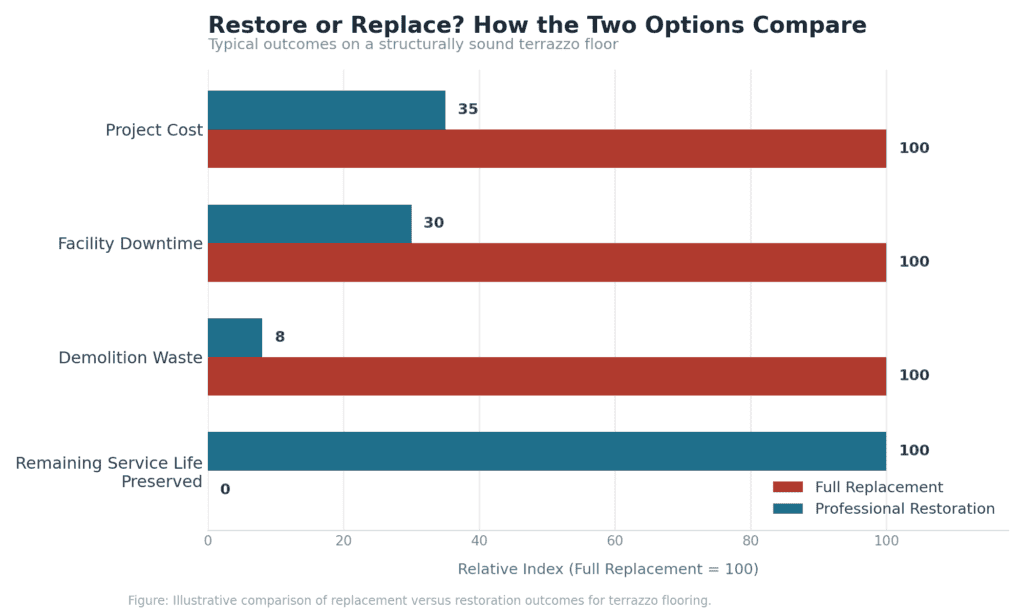
Infographic: Restoration preserves the existing slab, which is why it typically costs less, closes fewer areas, and sends far less material to the landfill than full replacement.
Terrazzo Is Often More Durable Than It Looks
Visible Wear Is Not the Same as Structural Failure
One of the biggest misconceptions about terrazzo is that visible wear automatically means the floor has reached the end of its life. A dull surface, light scratches, staining, and minor cracks can make a floor look severely damaged, but the visible condition of a terrazzo floor does not always reflect its structural condition.
Most of the damage you see sits in the top fraction of an inch. The slab and the marble aggregate underneath are usually intact, which is why so many worn floors respond well to professional terrazzo grinding and polishing. The process removes the damaged surface layer and exposes fresh, unworn material below it. The breakdown of the anatomy of a terrazzo floor explains why so much of the floor’s value lives beneath the surface.
What a Professional Assessment Reveals
Experienced restoration specialists routinely evaluate floors that building owners assumed needed replacement, only to find that the floor itself remains structurally sound. This is one reason terrazzo is known for an exceptional service life. Some installations continue to perform well after 75 to 100 years, and there are clear reasons why some 100-year-old terrazzo floors still look better than new flooring.
If you are unsure about the condition of your floor, the fastest way to get an answer is a free assessment and quote from a team that works with terrazzo every day.
Replacement Is Often More Expensive Than Expected
The Hidden Costs of Full Replacement
Facility managers generally understand that new flooring comes with a cost. What many do not anticipate are the additional expenses that accompany a full terrazzo replacement:
- Demolition and disposal of the existing floor
- Substrate preparation and leveling
- New material costs
- Installation labor and cure time
- Operational disruption across multiple departments
- Temporary facility adjustments, signage, and rerouting
These line items can increase the total project budget well beyond the original estimate. Restoration avoids most of them because the existing slab never leaves the building. A detailed terrazzo cost breakdown for property owners shows how the two paths compare on real projects.
Comparing Replacement and Restoration Honestly
When you compare replacement with restoration side by side, restoration frequently delivers substantial savings while preserving the existing flooring system. Many facility managers later realise that treating the floor as a long-term asset rather than a disposable finish would have achieved the appearance they wanted without the cost of tearing anything out.
Restoration Has Come a Long Way
Some decision-makers still picture restoration as a basic cleaning process. Modern restoration is far more advanced, and it draws on engineering methods that did not exist a generation ago.
What the Modern Restoration Process Includes
Structural Repair Methods
Mechanical Pinning
Movement in the substrate is what causes most repeat cracking. Mechanical pinning stabilizes the sections on either side of a crack so the repair holds instead of reopening. The case study on mechanical pinning as a solution for terrazzo repair and stabilization walks through how the method is applied in the field.
Hollow Plane Pressure Injection
When a floor sounds hollow underfoot, the terrazzo has separated from the concrete below it. Hollow plane pressure injection re-bonds the delaminated area with low-viscosity structural resin, which stabilizes the floor without demolition.
Crack, Substrate, and Aggregate Repair
Settlement cracks, spalls, and tack-strip holes are addressed through terrazzo crack and substrate repair, while damaged areas and old penetrations are rebuilt with precision patching and seamless small-scale installations. Color matching and graded marble chips make the repair blend into the original pour.
Surface Refinement Methods
Once the structure is sound, the surface is refined. Diamond grinding, honing, and polishing restore clarity and shine, and high-performance stone hardening densifies the matrix so the finish lasts. This is what allows a facility to stop stripping and waxing, an approach explained in the guide to moving beyond the wax.
The same principles apply to other hard surfaces in a building, including marble, travertine, and natural stone restoration and concrete polishing and surface finishing.
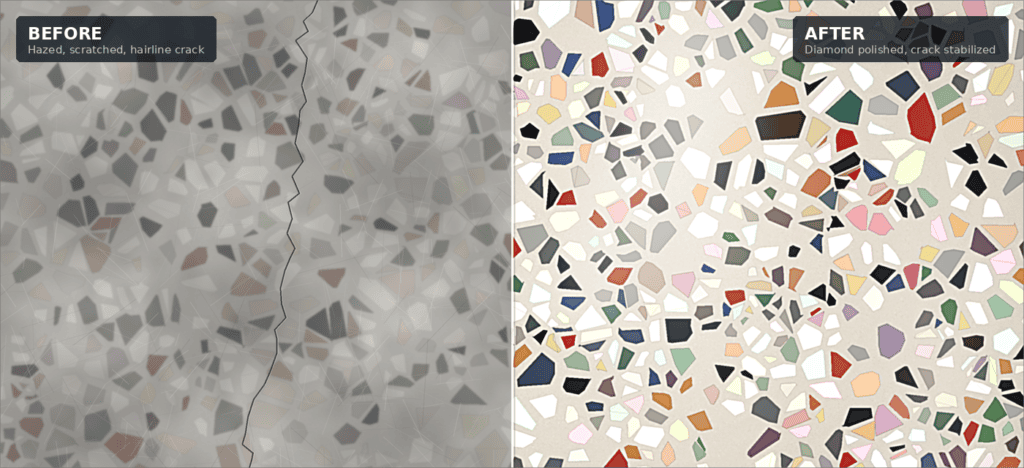
The same terrazzo floor, left half hazed and scratched with a hairline crack, right half after crack stabilization and diamond polishing. The marble aggregate was never the problem. Only the top fraction of an inch had to be removed.
Downtime Can Be a Bigger Problem Than Cost
Budget matters, but building operations are often the larger concern. In schools, hospitals, airports, and commercial facilities, shutting down sections of a building affects employees, patients, students, and customers.
Replacement projects almost always require longer and wider closures than restoration projects. For facilities that operate around the clock, minimizing disruption can be worth as much as reducing project costs, which is why terrazzo repair without replacement is so often the preferred path in active buildings.
Cracks Do Not Always Mean Failure
Cracking is one of the most common reasons facility managers start thinking about replacement. Visible cracks look alarming, especially in a lobby or main corridor. Many of them, however, are repairable.
Diagnosing the Cause Before Choosing a Fix
An experienced contractor evaluates the source of the damage before recommending a repair. That evaluation typically considers:
- Foundation movement
- Building settlement
- Moisture conditions below the slab
- Previous repair history
- Traffic patterns and load paths
Reading a floor this way has more in common with detective work than with flooring work. That idea sits at the center of terrazzo forensics and of what terrazzo damage can reveal about a building’s past. Understanding the source of a crack is critical before deciding whether replacement is truly necessary.
Proper Maintenance Can Prevent Major Expenses
A Practical Terrazzo Care Routine
Small maintenance investments prevent larger restoration expenses later. Routine care is one of the most effective ways to protect a flooring investment, and it does not require anything exotic:
- Regular dust removal
- Immediate spill cleanup
- Neutral pH cleaning products
- Scheduled deep cleaning
- Periodic polishing
- Timely sealing where the system calls for it
Following the smart way to maintain terrazzo floors long-term significantly extends the life of the floor while keeping its appearance consistent. Unfortunately, maintenance is often postponed until visible damage becomes impossible to ignore.
Maintenance Is Also a Safety Issue
Appearance is only part of the picture. A floor that has lost its profile, developed lippage, or been over-waxed becomes a liability, and there are usually warning signs long before an incident. Both when terrazzo becomes a safety risk and slip risks, liability, and compliance for property owners cover what to watch for.
Terrazzo Was Designed for High-Traffic Buildings
Facility managers sometimes compare aging terrazzo with newer flooring options without considering what the material was built to do. Terrazzo was developed specifically to perform in demanding environments, which is why it remains so common in schools, hospitals, and airport terminals.
These environments experience:
- Constant foot traffic
- Heavy equipment movement
- Frequent and aggressive cleaning
- Continuous, around-the-clock use
Few flooring materials match terrazzo’s ability to withstand these conditions over decades of service. When properly maintained, commercial terrazzo often outlasts multiple generations of alternative flooring. That durability is exactly what nationwide restoration crews are preserving when they are called into an occupied building.
Stains Are Not Always Permanent
Staining is another issue that pushes facility managers toward replacement. Water stains, chemical stains, and years of accumulated dirt can noticeably affect appearance.
The good news is that many stains can be addressed through professional restoration. Deep cleaning, terrazzo floor polishing, and refinishing often remove or dramatically reduce discoloration that first appears permanent. Before replacing a stained floor, have it professionally evaluated. As the hidden life of terrazzo shows, the results are frequently far better than expected.
Understanding Terrazzo Flooring Cost Over the Long Term
Lifecycle Cost Versus Initial Price
When evaluating flooring decisions, many facility managers focus primarily on initial cost. Long-term value tells a different story. Terrazzo may cost more to install than some alternatives, but its longevity changes the financial picture entirely.
Many flooring products need replacement every 10 to 20 years. Terrazzo can remain serviceable for generations, which usually results in a far lower lifecycle cost than repeatedly replacing less durable materials. The complete 2026 guide to terrazzo restoration puts current costs and repair options in one place. For this reason, many organizations continue to specify terrazzo for large public and commercial projects.
Epoxy Terrazzo Flooring Offers Additional Flexibility
Modern epoxy terrazzo has expanded what is possible for facility managers. Compared with traditional cement-based systems, epoxy terrazzo offers:
- Greater design flexibility
- Improved stain resistance
- A wider range of color options
- Reduced installation thickness
- Enhanced customization opportunities
These benefits make epoxy terrazzo an attractive option for both new construction and renovation. Even epoxy systems, however, benefit from regular maintenance and professional care.
The Value of Working With the Right Contractor
Perhaps the most important lesson facility managers learn is the value of partnering with genuine specialists. Not all contractors work in terrazzo. A knowledgeable terrazzo restoration contractor understands historic cement systems, modern epoxy systems, repair techniques, moisture-related issues, and surface preparation requirements. Reviewing the full range of restoration services is a practical way to gauge whether a firm has that depth.
Nationwide Coverage With Regional Crews
Coverage matters when a building needs a fast response. Facilities in Michigan, Ohio, Illinois, Indiana, Wisconsin, Pennsylvania, New York, New Jersey, North Carolina, and Florida are all supported by regional crews. Florida projects also have their own dedicated terrazzo flooring service, and the complete list of service locations shows where coverage is strongest.
Making an Informed Decision
The choice between restoration and replacement should never rest on appearance alone. A professional assessment reveals whether the floor is structurally sound and capable of being restored.
In many cases, facility managers discover that restoration delivers the appearance they want without the cost, disruption, and waste of replacement. Understanding the true condition of the floor lets decision-makers act on facts rather than assumptions. If a floor in your building is under review, request a structural assessment before the demolition line item ever reaches the budget.
Frequently Asked Questions
Assessment and Diagnosis
How do I know if my terrazzo floor needs replacement?
A professional evaluation is the only reliable way to determine whether replacement is necessary. Many floors that look worn can be fully restored. Additional answers are available on the terrazzo restoration FAQ page.
Can terrazzo floor cracks be repaired?
Yes. Professional crack repair addresses many types of cracking, depending on the cause and severity of the damage. Cracks driven by substrate movement are stabilized rather than simply filled.
Cost and Lifespan
Is terrazzo restoration less expensive than replacement?
In most cases, yes. Restoration typically costs significantly less than full replacement while extending the life of the existing floor and avoiding demolition and disposal.
What is the average lifespan of a terrazzo floor?
A properly maintained terrazzo floor can last 75 to 100 years or more, making it one of the longest-lasting flooring systems available.
Maintenance and Appearance
How often should terrazzo floors be polished?
Frequency depends on traffic levels and building use. High-traffic facilities benefit from periodic polishing to maintain both appearance and performance.
Can stained terrazzo floors be restored?
Many stains can be reduced or removed through professional cleaning, polishing, refinishing, and restoration techniques. A test area is the quickest way to confirm what is achievable.
Conclusion
Many facility managers who replace terrazzo floors later realize they had more options than they thought. Replacement is sometimes necessary, but countless floors can be successfully restored through professional repair, polishing, refinishing, and maintenance.
By understanding the true condition of the floor, evaluating long-term costs, and consulting experienced specialists, facility managers can make informed decisions that protect both their facilities and their budgets. Before replacing terrazzo, it is worth taking a closer look at what restoration can achieve. Get a free quote to find out where your floor stands, or browse the TerCon Systems blog for more on preserving the surfaces you already own.